
Foreign Correspondence, Vol 135
Alex Honnold on finding joy beyond fear

Hello, and happy almost Friday.
In my nearly decade-long career in journalism, I’ve witnessed many rounds of layoffs — but none quite as brutal as the one that befell The Washington Post this week.
Well, not “befell,” exactly. That makes it sound like an unfortunate accident or an inevitable twist of fate. The reality was far more deliberate.
“We’re witnessing a murder,” Post alum Ashley Parker, now of The Atlantic, wrote of the cuts, which eliminated the paper’s sports and books desk and gutted much of its metro and international teams, including its Ukraine and Jerusalem bureaus. “Jeff Bezos, the billionaire owner of The Washington Post, and Will Lewis, the publisher he appointed at the end of 2023, are embarking on the latest step of their plan to kill everything that makes the paper special. The Post has survived for nearly 150 years, evolving from a hometown family newspaper into an indispensable national institution, and a pillar of the democratic system. But if Bezos and Lewis continue down their present path, it may not survive much longer.”
That this dismantling of the U.S. capital’s paper of record comes at a moment of profound national upheaval only deepens the blow. As the country prepares to mark the 250th anniversary of its independence, President Trump is actively reshaping Washington in his own image: renaming its cultural institutions, bulldozing its centers of power, and even attempting to rewrite its history.
Meanwhile, in D.C. and across the country, ICE agents and border patrol continue to operate as vehicles of state terror, turning what was once heralded as a nation of immigrants into a hostile environment for the undocumented and documented alike.
In times of uncertainty and instability, journalists step in to provide clarity and, where possible, accountability. Hundreds of them — including many I admire and have been fortunate to call friends — have now lost their jobs. And make no mistake: Whatever Bezos may be saving in the process (as The New Yorker’s Ruth Marcus notes, his net worth has increased ten-fold since he purchased the paper in 2013), the rest of us have become immeasurably poorer for it.
What I’ve worked on

One week after rock climber Alex Honnold completed his live, ropeless ascent of Taipei 101, I spoke with him for Culture Current about how he handled the pressure — and why he’d do it again.
Questions are always centered around risk and consequences and the extremeness of it. And that totally makes sense. But it’s also tremendously fun to climb up the side of a building. In some ways it’s like the little kid in me gets to live his dream. You spend your life as a little kid looking up at things and being like, “That would be so amazing!” And then to actually get to do some of that as an adult, that’s so cool.
Plus:
My Q&A with Palestinian rapper Tamer Nafar on existing through art
Our City Memo’s from Milan, Lisbon, and Jersey City
Our new Inside Track newsletter! You can sign up for our special Winter Games edition here
What I’ve read
This essay by the mother of Hind Rajab on the second anniversary of her daughter’s death and the Oscar-nominated film that harrowingly reconstructs it:
When the filmmaker Kaouther Ben Hania contacted me to make a film about Hind’s last hours, I was hesitant. I was still drowning in grief. The idea of reliving those moments terrified me. But I also knew that if the world did not listen to Hind, her killing would become another lost number. Maybe if the world heard her voice, I thought, other children could be saved.
This piece on Gaza’s ceasefire in name only:
This may be the best arrangement Palestinians can expect under the current framework—a managed status quo that staggers on while satisfying no one. Displacement, insecurity, and death continue, just at a pace that doesn’t trigger international intervention. Israeli forces justify their lethality as a security response to Palestinian provocations. What matters is that this managed level of devastation is low enough to preserve the ceasefire’s diplomatic framework but high enough to maintain tactical pressure. Through it, Israel allows continued military presence without the political costs of full-scale war.
This long read on Princeton researcher Elizabeth Tsurkov’s 903-day captivity in Iraq:
An officer who introduced himself as Maher led the interrogations. He wore a balaclava throughout so that I would not be able to identify him. The idea of a Russian doing academic research on Iraq was utterly befuddling to Maher and his colleagues. They felt that as a Russian, I should research Russia alone. Maher promised that if I was able to prove that foreign researchers conducted fieldwork in Russia, then he would be my “greatest defender.” When I started listing some, he looked downcast. He did not become my greatest defender.
The interrogators kept threatening me with torture, but in those opening weeks, they refrained from acting on the threats—I assume on orders from higher up. Instead, because they were clearly untrained in conducting interrogations that did not involve torture, they fell back on interrogation methods they had probably seen in movies. To intimidate me, Maher would blow smoke in my face, but because he was using an e-cigarette, all I got was a gust of strawberry-smelling vape. It wasn’t quite the tough-guy routine he was after. Later, he tried the “good cop, bad cop” routine on me but undermined the effect by playing both characters himself, on alternate days, which just made him seem deranged.
What I’m thinking about
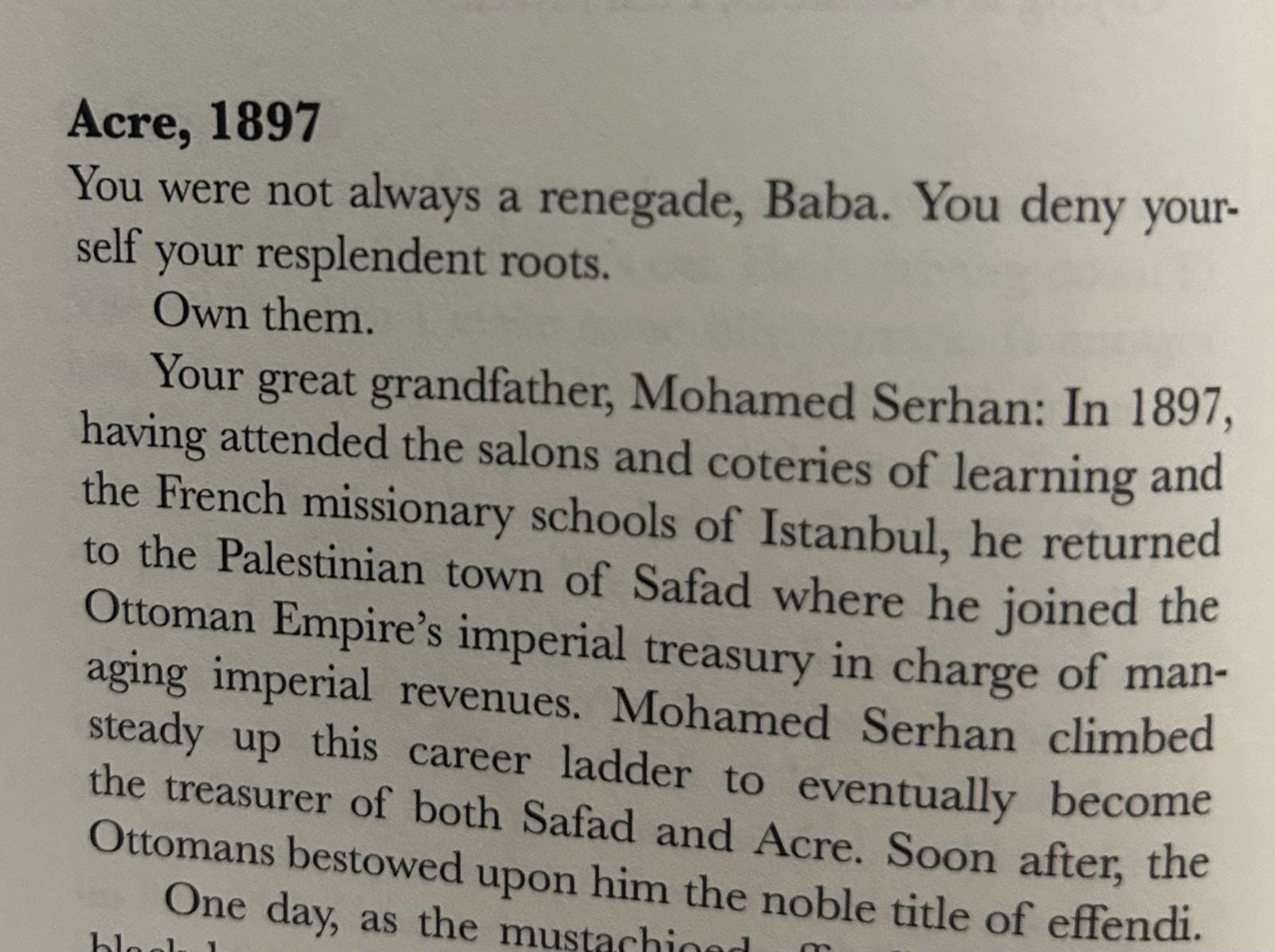
One of the first books I’ve read this year is I Can Imagine It for Us by Palestinian writer Mai Serhan. It’s rare to read a memoir about someone else’s life and family that allows you to learn so much about your own — as it turns out, Mai is a distant cousin of mine and both our paternal lines hail from the village of al-Kabri in what is modern day Acre, in northern Israel.
Here’s what she wrote about our great great grandfather, Mohamed Serhan:
Until next time,
Yasmeen