
Foreign Correspondence, Vol 139
Joey D’Urso on the politics stitched into soccer shirts

Hello, and happy Friday!
In our last correspondence, I speculated that I might become a little insufferable if my beloved Arsenal won the Premier League — a feat that, at that point, had eluded the club for more than two decades.
In this one, I can confirm that I was right to be concerned.
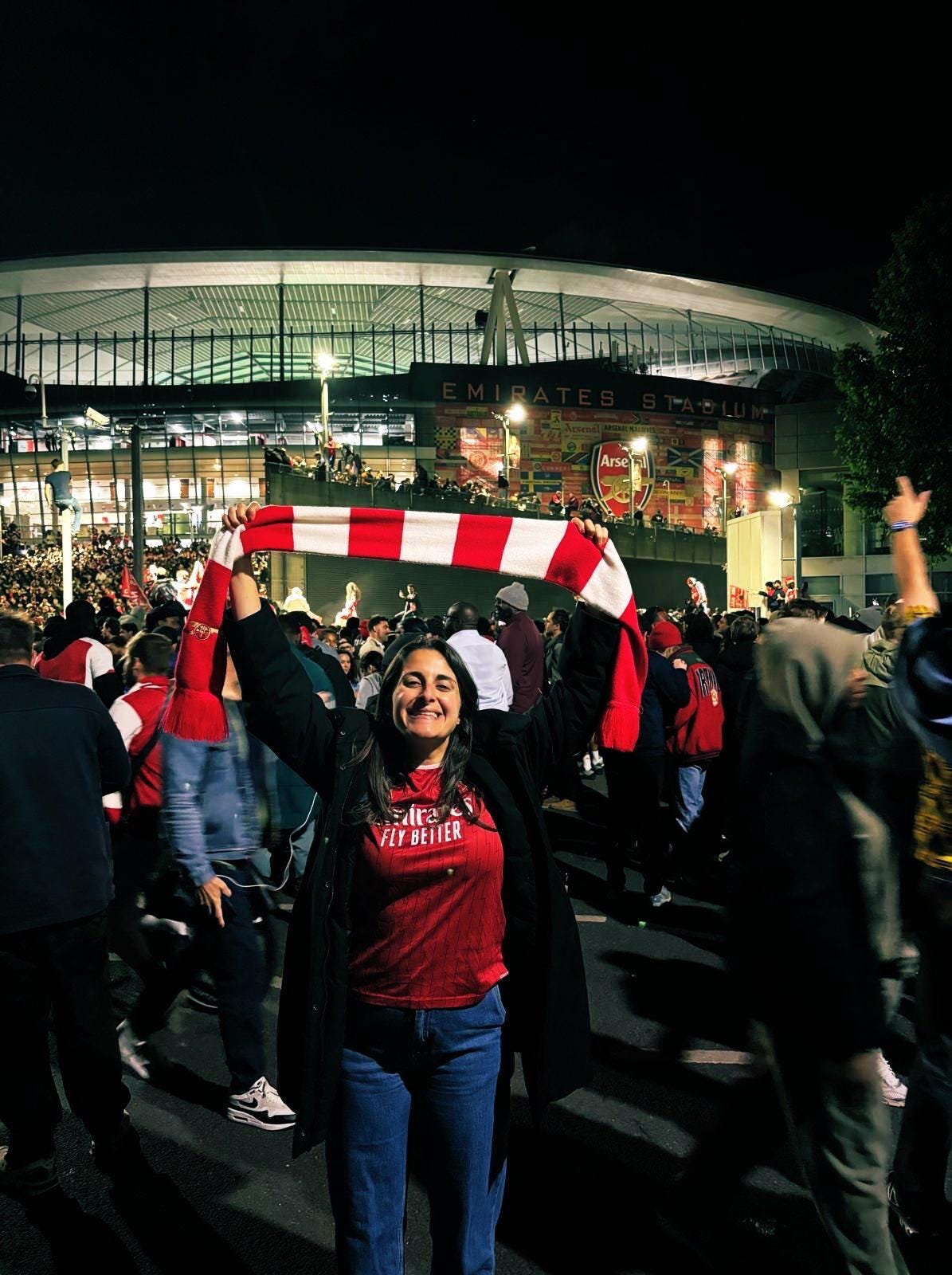
My history with Arsenal probably doesn’t go back as far as those pictured around me. It wasn’t until I moved to North London in September 2017 that my new housemates suggested (read: instructed) that I support our local team. My better half, a lifelong Gooner, similarly implied (read: demanded) the same.
Fast forward nearly a decade, and I’m now the type of person that tries to hopelessly stream the Champions League final mid-transatlantic flight — much to the delight of the cabin crew and fellow passengers who huddled around my phone for the penalty shootout.
With the Premier League season at a close, my — and the wider world’s — attention now turns to the beautiful' game’s biggest stage yet: the World Cup. Scroll on for an interesting conversation about the politics stitched into soccer shirts, how to follow my colleagues’ coverage from the tournament, and what I’ve been reading — football and non-football related — ahead of this week’s kickoff.
What I’ve worked on

For our latest Culture Current, I caught up with “More Than A Shirt” author Joey D’Urso about soccer’s soft power and how to read the stories stitched into the game’s biggest stage.
There’s lots of really interesting stories about why a certain team wears a certain color. Germany, for example, play in white and black because it was (the colors of the) flag of Prussia, which was a sort of pre-German state. But there’s some really interesting stuff about Germany and the flag and football because (under) Hitler and the Nazis, they’re still playing white and black. But then after the war, Germany weren’t in the 1950 World Cup because the place was in rubble and Germany was banished from all sorts of things. But in 1954, (in what) they call “the miracle of Bern” in Switzerland, Germany won. Then, in 2006, Germany hosted the World Cup and the flags were everywhere. And that’s the first time the flag would be prominent in a sort of healthy, patriotic way that isn’t associated with racism and whatever else.
Another interesting shirt is (the yellow jersey of) Brazil — the most iconic football shirt in the world. But it actually comes from this spectacular failure of 1950 when Brazil hosted the World Cup. It completely expected to win and it built the Maracanã, which is a sort of cathedral to football, and it lost against little Uruguay in the final. It was like a national tragedy for Brazil and it’s so seared into their memory. They played in white in that final, and then they were like, “This white is so cursed, we need a new shirt.” So they did a competition and the yellow came out of that.
Plus:
This week, we launched a special World Cup edition of Inside Track, delivering the biggest stories, stakes and standout moments from the tournament to your inbox three times a week. Sign up here
Our latest editions of Emotional Currency, from mini retirements to reimagining major milestones
What I’ve read
This great profile on Saint Levant, whose latest song “Sabah El Ward” has been the soundtrack to my mornings:
At a time when Palestine had produced a tragically galvanising moment for Arabs, Saint Levant emerged as the region’s first bona fide commercial Palestinian pop artist, and in the process had become one of the biggest stars in the Middle East. The few Palestinian artists who had made it big before him had done so through rousing political anthems. Among other Arab artists, Palestine was the preserve of older generations, who had produced now canonical songs of yearning and lament for Palestine. A singer who was of Palestine, but broke with the sobriety of expression about it, was a shock to the system in a way that was invigorating and scandalising.
This impressive catalogue of players to watch at the World Cup from The Athletic:
This list is not a collection of rankings. Instead, we’ve put these players into one of five categories: Legends, Superstars, Key players, Rising stars and Unsung heroes. You can sort or filter them however you’d like, including by country or professional club. Each link leads to a comprehensive profile, detailed charts breaking down a player’s most important characteristics and a name pronunciation guide.
This piece from my Reuters colleagues on the science behind the perfict pitch:
Natural grass alone can no longer withstand the demands of the modern game. Matches are more frequent, the sport is faster and every bounce, slip and divot is televised and scrutinised.
The green surface that millions will watch through June and July is the result of a process that began months earlier — a living floor built to perform under the world’s gaze.
This dispatch from the conservative womanosphere:
It is difficult to tidily define womanhood, or to attach to the term a set of clear expectations. Yet Turning Point, the conservative organization founded by the late Charlie Kirk, professes to understand womanhood deeply—so deeply, in fact, that it holds a conference every June to elucidate the concept: Womanhood is getting married as soon as you can, and having babies—more “than you can afford,” as Kirk often advised. It is embracing God and renouncing feminism.
But the messages from this year’s speakers and attendees were different than in years past: So diverse and inclusive that the summit occasionally felt, dare I say, a little feminist.
What I’m thinking about
Britain’s malaise — laid bare in this piece — and who might be able to reverse it.
Andy? Anyone?!
Until next time,
Yasmeen